
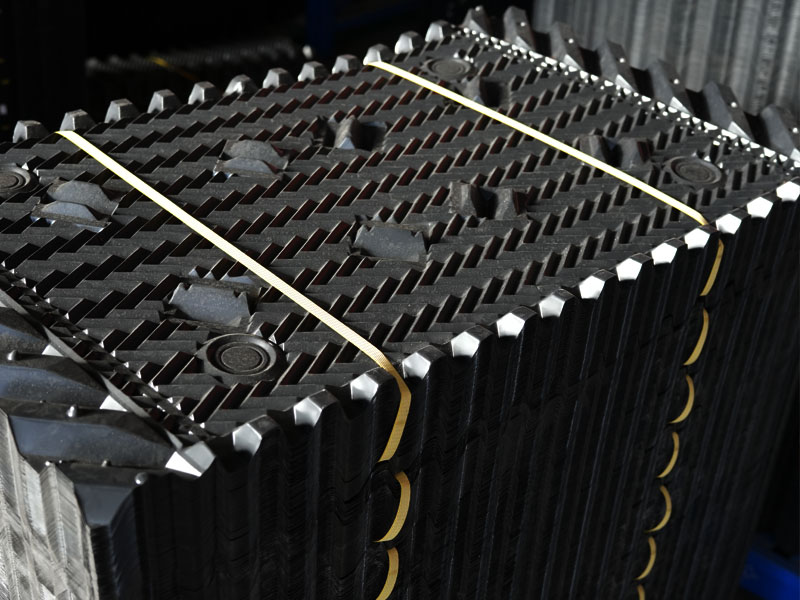
If you manage cooling towers in Southeast Asia, you already know the climate works against you: high humidity, warm wet-bulb temperatures, and aggressive biological growth. The internal media — the Cooling tower Fill — is the part that actually does the cooling job. Pick the wrong type and your tower runs hotter, uses more energy, and needs more maintenance. Pick the right one and you get consistent cooling, predictable maintenance cycles, and real savings.
What is Fill?
The fill is simply the surface area inside the tower where water spreads out so air can evaporate a portion and remove heat. Some fills make water into thin films across corrugated surfaces; others break water into droplets with splash elements. Either way, the goal is the same: create lots of water/air contact with minimal energy loss.
Types of Fill — Which design suits your tower?
Film Fill — modern, efficient, space-saving
Film fill (often used in film fill cooling tower designs) uses thin, closely-spaced sheets that force water to spread out in a thin layer. This gives high surface area and excellent heat transfer for a given volume. Because film fills are compact, they work great when space is limited or when you need a tight approach margin.
Corrugated Fill — the structured choice
Corrugated Fill refers to the way the sheets are shaped (wavy or chevron patterns) to promote thin film formation and orderly flow. Corrugated, structured packs lower channeling and help water distribute uniformly. They’re commonly used in counterflow and some crossflow towers where performance and low pressure drop matter.
Splash Fill — tough and forgiving
Splash fills use blocks or ladders that intercept water and break it into droplets. They’re heavier and bulkier but are less likely to clog from sediments or biological buildup. That makes splash fill a practical choice in plants with poor water quality or heavy solids.
Materials — which one handles your conditions best?
The material choice dramatically affects longevity:
- PVC: Cost-effective and thermally efficient for film fills. Choose UV-stabilized options in open or coastal installations.
- Polypropylene (PP): Better chemical resistance and higher temperature tolerance than standard PVC — a good step-up when your process fluids are harsh.
- Polyethylene & HDPE: Often used for splash elements; robust against impact and abrasion.
- Fiberglass Reinforced Plastics (FRP): Used for structural parts, supports, and collectors to avoid corrosion in salty or acidic environments.
- Metals (stainless steel): Occasionally used for structure, but rarely for film sheets due to cost and fouling.
Matching Fill to Tower Types — practical pairings
Here’s how to think about the match:
Counterflow towers
These often pair best with structured film packs (corrugated designs). The compact, high-surface-area packs suit counterflow geometry and give efficient approach temperatures.
Crossflow towers
Crossflow designs can accommodate film or splash fill, but ensure your drift eliminator and distribution basins match the fill’s flow pattern to avoid dry spots and channeling.
Retrofits and conversions
Retrofitting old towers is common — moving from splash to a film pack can boost performance if distribution and fan capacity are right. Always check pressure drop and fan curve — you don’t want to overload fans with a higher-resistance pack.
Performance & Efficiency — what metrics to watch
When evaluating fill, watch three practical metrics:
- Approach temperature: How close to ambient wet-bulb the tower can cool. Lower is better.
- Pressure drop: The resistance fill adds. Lower pressure drop saves fan energy.
- Fouling resistance: How quickly solids or biofilm reduce the effective surface area.
A high-quality film pack often wins on approach and compactness; a splash pack wins on resilience and low fouling in dirty-water applications.
Buying Checklist — what to provide to your supplier
To get an accurate quote and the right product, prepare:
- Process duty (kW or refrigeration tons), flow (m³/h), and desired approach or outlet temperature.
- Detailed water report (TDS, suspended solids, bioload, pH, chemical dosing scheme).
- Photos or drawings of your tower internals — inlet, distribution system, basins, and any obstructions.
- Service expectations — local maintenance capability, replacement lead time tolerance, and budget constraints.
Sizing & Custom Cut Services — we make it fit
Standard modular packs speed installations, but many towers need custom pocket sizes, notches, or cut-outs. Our factory offers:
- Pre-cut blocks to your cell geometry.
- Edge trimming for louvers, intake grilles, and basin interfaces.
- Pre-assembled trays or packs for quick swap-outs during shutdown windows.
If your team can send a simple sketch or a photo with a ruler or reference, we can propose cut-to-fit options and supply an installation checklist so the on-site crew avoids common pitfalls.
Installation Tips — avoid the rookie mistakes
- Level the lower supports before placing packs — uneven supports lead to channeling and early failure.
- Install drift eliminators correctly — misaligned drift elements cause water carryover and scaling.
- Don’t force packs into undersized slots — trim them precisely or request a custom cut.
- Keep records of pack serials and installation dates — that helps predict replacement cycles.
Maintenance Routines — simple steps to keep performance up
A few practical habits will keep your cooling tower fills working longer:
- Inspect visually monthly during high-use seasons; look for sagging, discoloration, and biofilm.
- Clean distribution trays and nozzles regularly — uneven distribution is the #1 killer of thermal performance.
- Use soft pressure-washing for film sheets; avoid solvents unless the fill material is rated for them.
- Replace modular packs in sections instead of piecemeal — that makes future maintenance predictable and cheaper.
Common Problems & How to Diagnose Them
We’ve seen operators describe “sudden loss of cooling” and it’s often one of these:
- Blocked distribution: Check nozzles and basins first.
- Channeling: Caused by poor packing or warped sheets — look for dry streaks during operation.
- Biological fouling: Regular dosing and mechanical cleaning prevent the worst cases.
Environmental & Local Considerations — Southeast Asia focus
In the region, pay special attention to:
- High humidity and warm water temperatures accelerate biological growth — stronger maintenance routines needed.
- Coastal sites require UV- and salt-resistant materials for longer life.
- Monsoon seasons mean higher suspended solids during heavy rains — consider pre-filtration or robust splash packs in these months.
Related components we manufacture
To get the most from your fills, remember the other parts matter too. We also make the Air intake grille which improves airflow and keeps large debris out, and the Cooling tower water collector which helps manage basin flow and reduce carryover. Combining the right fill with these components reduces headaches and extends service intervals.
How we can help — practical services
- Consultation based on photos and duty data.
- Custom cutting and pre-assembly to your cell geometry.
- Local packaging and shipping for faster on-site availability in Southeast Asia.
- Technical installation guidance and spare parts lists for maintenance teams.
Want a quick, no-fuss recommendation?
If you’re unsure which fill or material suits your tower, send us drawings, photos, or a short video of the tower internals. Even a smartphone snapshot with a tape measure helps. We’ll review and propose a practical solution — cut-to-fit if needed — and include an installation checklist so your team can replace packs quickly and safely.
Leave a comment
All fields marked with an asterisk (*) are required