About Us
We are professional cooling tower fills manufacturer, which can supply wide ranges of cooling tower fills with PVC, PP or CPVC materials.

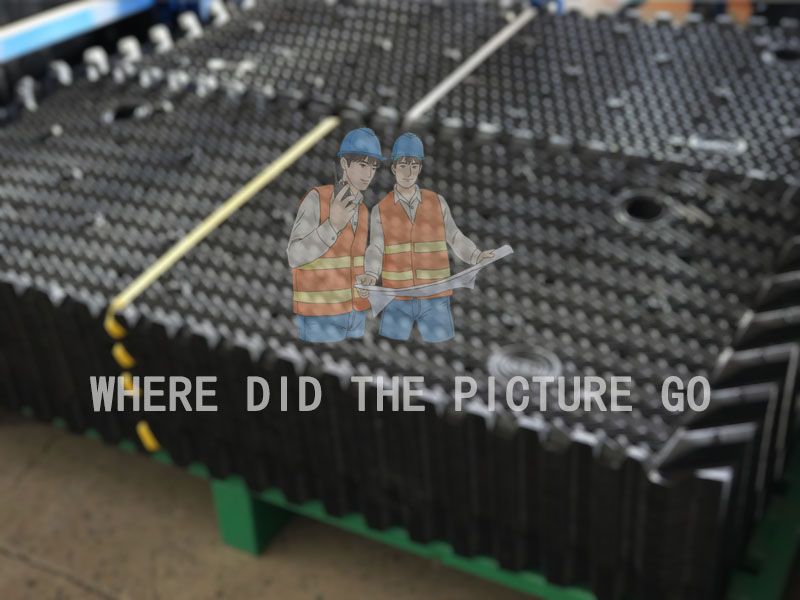
Water distribution inside a cooling tower determines how evenly water spreads across the cooling tower fill. Good distribution means uniform thin water films, consistent heat transfer, and predictable plant performance. Poor distribution creates dry spots, channeling, uneven approach temperature and increased energy consumption. This guide explains practical ways to optimize cooling tower water distribution for industrial systems.
When circulating water leaves the basin and is re-introduced at the top of a tower, the distribution system must deliver that water evenly across the full face of the fill. The goal is simple: every square meter of fill should receive roughly the same mass flow so evaporation and heat exchange are uniform.
Key performance impacts from poor distribution:
Most distribution issues fall into a few categories:
Select nozzles based on flow rate, droplet size and spray pattern. Common nozzle styles include:
When choosing nozzles, match the nozzle manufacturer's flow table to your design flow per cell and desired droplet spectrum. Too-large droplets reduce evaporation; too-fine droplets may drift and increase drift loss unless proper eliminators are installed.
Basins and headers should deliver uniform pressure to each nozzle. Design tips:
For multi-cell towers ensure each cell receives the designed flow by including flow meters or calibrated orifice plates at the cell inlet.
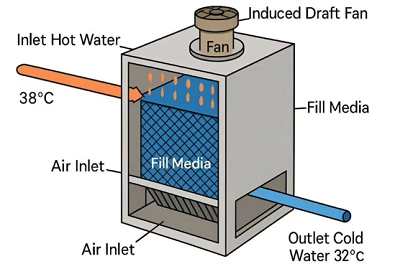
Trays or decks that support nozzles and guide water must be kept in good condition:
In retrofit projects replacing aged trays with modular, easy-clean designs reduces long-term maintenance time.
Pump performance and piping friction affect distribution. Key checks:
Variable speed drives can be used to match pump output with changing process loads while monitoring distribution uniformity.
Practical measurements that reveal distribution issues:
For large or unusually shaped towers, Computational Fluid Dynamics (CFD) helps diagnose complex interactions between nozzles, fill geometry and airflow. CFD can predict where channeling or low-velocity zones will occur and guide nozzle repositioning, nozzle type changes or internal baffle additions.
Use CFD outputs to create simple field tests that validate predicted improvements before committing to full replacement or retrofit.
If inspection shows chronic distribution issues, consider these retrofit options:
Routine care keeps distribution stable:
Combining simple mechanical maintenance with a targeted water treatment program gives lasting benefits to distribution performance.
Distribution works best when paired with the right fill and drift eliminators. Consider complementary upgrades such as high-efficiency Air Intake Grille to improve airflow uniformity and Cooling Tower Water Collector for better water recovery and reduced splash that disturbs distribution patterns.
A medium-size industrial plant reported rising approach temperature in one cooling cell. Infrared inspection showed a thermal strip aligned with a clogged nozzle row. The plant replaced the nozzle string with a rotary self-cleaning type, adjusted header balancing valves and cleaned the basin. Approach temperature returned to design within 48 hours and fan energy dropped by 6 percent. This illustrates how focused distribution fixes produce quick, measurable gains.
Optimizing water distribution is one of the most cost-effective ways to recover or improve cooling tower performance. Regular inspection, correct nozzle and tray selection, balanced pumping and occasional CFD support for complex systems are the practical building blocks. When distribution is even, the fill works at its best, evaporation is maximized and plant energy use falls.
If you suspect distribution problems or plan a retrofit, send us nozzle layouts, basin photos or flow data. We provide practical recommendations, custom distribution trays and factory-cut fill blocks to restore even coverage quickly.
Send Drawings and Request Distribution Review
Leave a comment
All fields marked with an asterisk (*) are required