About Us
We are professional cooling tower fills manufacturer, which can supply wide ranges of cooling tower fills with PVC, PP or CPVC materials.

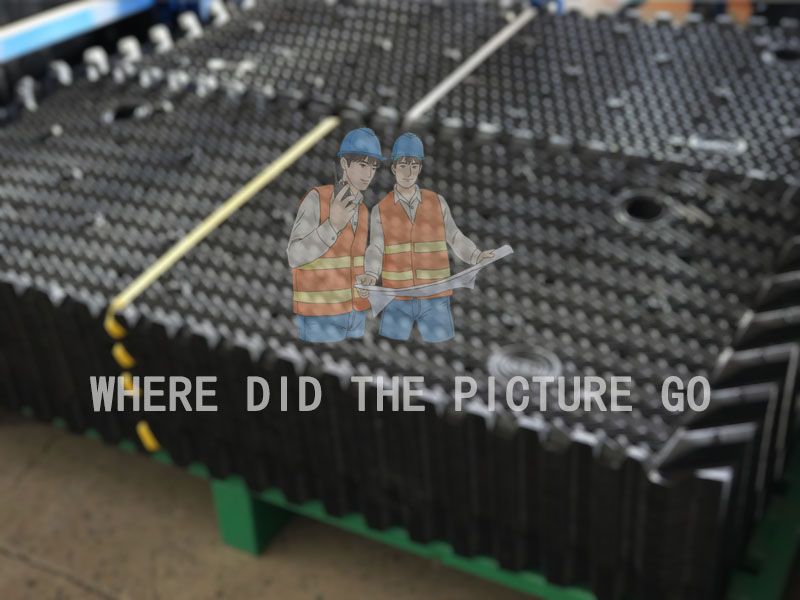
In many operating plants, cooling performance gradually declines without obvious equipment failure. Engineers often check fans, pumps, and piping—but overlook the cooling tower fill. In reality, aging or mismatched cooling tower fill media is one of the most common reasons for unstable outlet temperature and rising energy costs.
Especially in Southeast Asia and the Middle East, high humidity, dust, and biological growth accelerate fill degradation. If the cooling fill is not properly selected or maintained, system efficiency drops faster than expected.
Cooling tower fill is the internal heat exchange structure that increases the surface area of water and improves contact time with airflow. It transforms bulk water into thin films or droplets, enabling efficient heat dissipation.
From an engineering perspective, tower fill defines the actual cooling capability more than any other internal component.
Film fill cooling tower systems create continuous water films over structured sheets. This design delivers high thermal efficiency when water quality is controlled.
Splash fill cooling tower breaks water into droplets through repeated impact, reducing sensitivity to contamination.
Corrugated fill uses angled channels to guide water flow, balancing efficiency and fouling resistance.
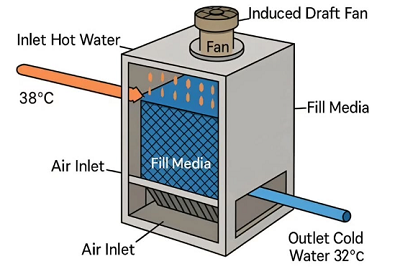
PVC Cooling Tower Packing is widely used due to its affordability and ease of installation.
PP Cooling Tower Fill Media provides higher durability in demanding environments.
The effectiveness of cooling tower fill directly impacts system performance. A well-designed cooling tower fill design ensures even water distribution and stable airflow.
From field experience, replacing outdated cooling tower fill material can reduce outlet temperature by 2°C to 4°C, which significantly improves downstream process efficiency.
Critical factors affecting cooling tower fill efficiency include:
Selection should be based on actual operating conditions rather than standard specifications.
Procurement should also consider long-term maintenance cost instead of only initial price. In many cases, investing in higher-grade cooling tower fill media reduces total lifecycle cost.
Related internal solutions:
Cooling tower fill clogged conditions occur when debris, algae, or suspended solids accumulate. This blocks airflow and reduces heat exchange efficiency.
Mineral deposits form on the surface of cooling tower fill material, reducing effective contact area and increasing thermal resistance.
Exposure to heat, UV, and chemicals causes material brittleness and deformation, leading to reduced performance over time.
High humidity and biological growth caused repeated clogging. Switching from film to splash fill reduced cleaning frequency by over 30** and stabilized operation.
In a petrochemical facility, PVC fill softened under continuous high temperature. After replacing with pp cooling tower fill, service life doubled and system stability improved.
A plant using recycled water experienced severe fouling. Installing cooling tower fill for dirty water significantly reduced scaling and improved airflow consistency.
The selection and condition of cooling tower fill play a decisive role in system efficiency and reliability. By matching the right cooling tower fill media to actual operating conditions, engineers can reduce maintenance costs, improve performance, and extend equipment lifespan.
Typical signs include rising outlet temperature, uneven water distribution, and increased fan load.
Dirty water requires splash or anti-clogging designs, while clean water allows high-efficiency film fill.
Yes, upgrading can improve efficiency and reduce long-term operating costs.
PP is generally more durable than PVC in high temperature and aggressive environments.
Maintenance frequency depends on water quality but should be scheduled regularly to avoid unexpected failures.
This content is based on over 10 years of field engineering experience in industrial cooling tower systems across Southeast Asia and the Middle East. Insights are derived from real operational data, troubleshooting cases, and system optimization practices, aligned with ASHRAE and Cooling Technology Institute CTI recommendations.
Leave a comment
All fields marked with an asterisk (*) are required