About Us
We are professional cooling tower fills manufacturer, which can supply wide ranges of cooling tower fills with PVC, PP or CPVC materials.


Crossflow cooling towers are widely used in industrial facilities because of their simple structure, stable operation and relatively low energy consumption. However, the actual cooling performance of a crossflow tower depends heavily on the condition and design of the cooling tower fill. When the fill is properly selected and maintained, a crossflow tower can deliver stable cooling capacity for many years.
This guide explains how cooling tower fill influences crossflow tower performance and what industrial operators can do to improve cooling efficiency through proper fill selection, maintenance and replacement planning.
In a crossflow cooling tower, hot circulating water flows downward through the fill while air moves horizontally across the falling water. The airflow crosses the water path, which is why this design is called crossflow. During this process, a portion of the water evaporates and removes heat from the remaining water.
The cooling tower fill provides a large contact surface where air and water can interact. The greater the surface area and the more uniform the water film, the more effective the heat exchange becomes.
Cooling tower fill is the core component that determines thermal efficiency. Film fill structures allow water to spread into thin layers across corrugated sheets, creating a large evaporation surface. In crossflow towers, this process is particularly important because water distribution relies heavily on gravity and basin overflow systems.
Well designed fill performs several functions simultaneously:
When the fill becomes fouled or damaged, these functions weaken and cooling performance declines.
Many industrial cooling towers experience gradual efficiency loss due to aging or fouled fill materials. Typical symptoms include:
These issues are often incorrectly attributed to fan or pump problems, while the real cause is degraded cooling tower fill.
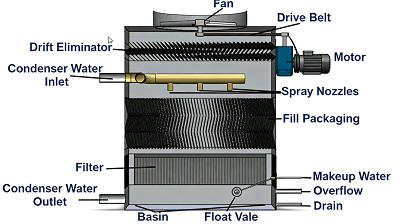
Modern film fill designs offer improved performance compared with older splash fill structures. Advanced PVC or polypropylene sheets feature optimized corrugation patterns that increase surface area while maintaining airflow passages.
Key benefits include:
These improvements allow industrial plants to achieve better cooling performance without increasing tower size.
Fill geometry plays a major role in determining airflow resistance and water distribution. The angle and spacing of corrugated sheets influence how water spreads across the fill surface.
Optimized geometry provides:
Crossflow towers benefit particularly from structured fill patterns that maintain uniform water coverage from top to bottom.
Even high quality fill requires regular inspection and maintenance. Over time, minerals, biological growth and airborne particles accumulate on the fill surface.
Recommended maintenance practices include:
Preventive maintenance significantly extends the service life of cooling tower fill.
Eventually, cleaning alone cannot restore fill performance. When fill sheets become brittle, warped or heavily blocked, replacement is the most effective solution.
Common indicators for replacement include:
Replacing aging fill often restores cooling tower efficiency quickly and reduces operating cost.
When selecting replacement fill for crossflow towers, industrial buyers should evaluate material quality, manufacturing consistency and supplier experience.
High precision thermoforming ensures uniform sheet thickness and stable geometry across large fill blocks. Quality materials resist UV exposure, scaling and mechanical deformation during long term operation.
For detailed product specifications and available models, visit the Cooling Tower Fill product page.
Besides fill materials, several other components influence crossflow tower efficiency. Proper airflow management and water recovery systems help maintain stable operation.
Industrial operators often upgrade multiple components together for maximum improvement, including the Air Intake Grille and the Cooling Tower Water Collector. These components improve airflow distribution and reduce water loss, supporting the overall cooling process.
Crossflow cooling tower performance depends heavily on the condition and design of the cooling tower fill. By maintaining clean fill surfaces, selecting high efficiency materials and replacing aging components at the right time, industrial facilities can significantly improve cooling efficiency and reduce energy consumption.
Regular inspection and timely upgrades allow crossflow cooling towers to operate reliably for many years while maintaining stable plant temperatures.
If you are planning to replace cooling tower fill or upgrade crossflow tower performance, send us your tower dimensions or project drawings. Our team can recommend suitable fill models and provide factory direct quotations for industrial projects.
Request Technical Advice
Leave a comment
All fields marked with an asterisk (*) are required