
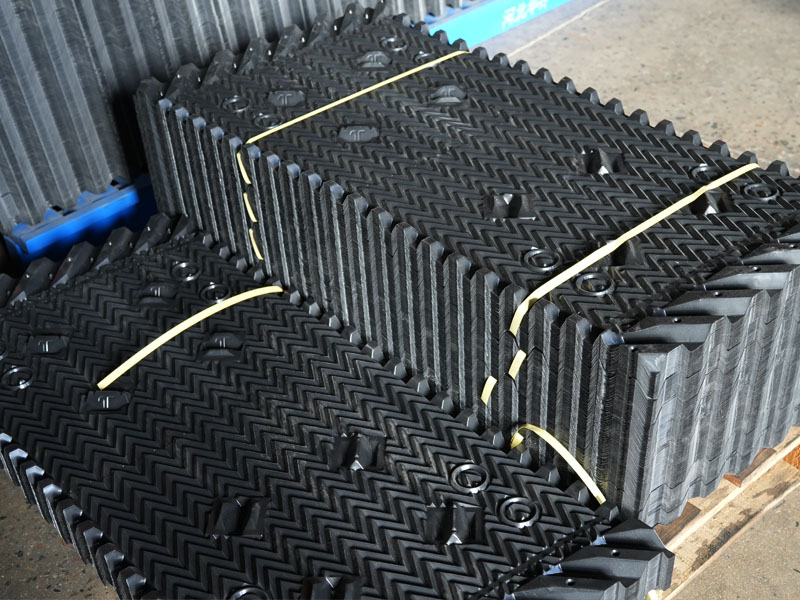
If you run or maintain a cooling tower in Southeast Asia, the single most important internal part you’ll interact with (after pumps and nozzles) is the cooling tower fill. In plain terms, the fill (sometimes called Cooling Tower Media or Cooling Fill) is the material inside the tower that spreads water into thin films or droplets so heat can transfer to passing air. Good fill = better heat exchange, lower approach temperature, less energy waste, and longer equipment life. Bad or worn-out fill = higher operating costs, reduced capacity, and frustrating downtime.
Fill Types & Structures — Film Fill vs Splash Fill, Corrugated Fill and more
Film Fill (structured / corrugated)
Film Fill (or film fill cooling tower) is commonly used in modern industrial towers. Sheets or corrugated sheets create a thin film of water over a large surface area — that’s where the name comes from. Corrugated Fill and other structured packs are designed to maximize contact area while keeping pressure drop low. These are ideal when you want high thermal efficiency in a compact volume.
Splash Fill
Splash fill is older but still useful where water quality is poor or when mechanical robustness is required. Water breaks into droplets as it strikes splash elements — heavier, less prone to clogging, but typically less efficient per unit volume than film fill.
Common Structures
- Modular packs (stackable blocks) — easy to replace and customize.
- Sheet / chevron corrugated designs — higher surface area and low drift.
- Valve-type and ladder-type splash elements — robust and simple to clean.
Materials — What the fill is made of and why it matters
Choosing the right material depends on climate (tropical, saline air), water chemistry, and budget. Common materials:
- PVC (Polyvinyl Chloride) — Widely used for film fill. Good thermal performance and cost-effective. Beware of high-UV exposure — choose UV-stabilized grades.
- Polypropylene (PP) — Higher chemical and temperature resistance than standard PVC; often used where glycol or chemicals are present.
- Polyethylene (PE) — Sometimes used for splash elements; robust and cheaper but heavier.
- FRP / Composite frames — used for supports and housings to resist corrosion.
- Stainless steel / metal — occasional use for structural parts; not common for modern film fill sheets due to cost.
Cooling Tower Types — Which fill fits which tower?
Different cooling towers and applications favor different fill types:
Induced-draft counterflow towers
Best paired with high-efficiency film fill packs (structured/corrugated). These towers benefit from low pressure drop and high contact area — ideal for process cooling and HVAC systems that need tight approach temperatures.
Induced/forced-draft crossflow towers
Crossflow towers can use either film fill or splash fill depending on fouling risk. Film fill is common for compact designs; splash for harsher water.
Natural-draft towers and large industrial cells
Typically use rugged splash filling or heavy-duty structured fill designed for large flows and easy maintenance.
Performance & Efficiency — What to expect from good fill
Fill determines approach (how close tower can cool to wet-bulb temperature), tower capacity, and fan/pump power. High-quality Film Fill packs can reduce approach by several degrees compared to worn or low-grade fills.
- High surface area = better heat transfer per cubic meter.
- Low pressure drop = lower fan energy use.
- Good drift control and splash design = less water loss and chemical carryover.
Buying Guide — What to check before you buy tower fill
Buying fill is not just about price. Here’s a checklist that helps customers in Southeast Asia make a practical decision:
- Know your target approach and flow rate — Provide design duty (in kW or TR), flow (m³/h), and desired approach temperature.
- Water quality — Hardness, suspended solids, biological load, and chemicals. High suspended solids favor splash fill or anti-fouling designs.
- Material resistance — If you’re near the coast or using treated water, choose UV- and salt-resistant materials (ask about stabilized PVC or PP options).
- Modularity & replaceability — Modular packs are faster to replace and cheaper to stock spare parts for.
- Certifications & testing — Ask for performance curves or test reports if efficiency is critical.
- Lead time & customization — In-region manufacturing or stock reduces downtime — we can customize size and cut-to-fit.
Sizing & Customization — Fixed sizes vs made-to-order
Off-the-shelf blocks work for many towers, but real-world installations often need custom cuts, pockets, or notches to fit louvers and distribution basins. We supply:
- Standard modular block sizes for quick swaps.
- Custom-cut corrugated fill to match unusual cell geometries.
- Pre-assembled packs for fast installation.
If you give us drawings or photos of the tower internals, we can propose a cut-to-fit solution and provide a simple installation guide — ideal for on-site teams with limited downtime windows.
Daily & Periodic Maintenance — Keep the fill performing
Regular care keeps thermal performance high and extends fill life. Practical tips:
- Inspect drift eliminators and fills visually every 3–6 months depending on load and water quality.
- Clean distribution nozzles and basins to prevent uneven water spread — uneven distribution is the fastest way to kill performance.
- Use gentle pressure washing for film packs, avoid aggressive chemicals that can damage PVC unless the fill material is rated for them.
- Monitor chemical dosing and keep biological growth under control; fouling reduces effective surface area quickly in warm climates.
- Replace packs in modular approach — swapping a single bad pack is cheaper than replacing the whole tower later.
Common Problems and Quick Fixes
Clogged channels: backflush and check the distribution. Warped sheets: check for UV or heat exposure and replace with UV-stabilized grades. High drift: replace or re-align drift eliminators and check fill spacing.
Why choose our fills?
We work with customers , so we design with humidity, high wet-bulb conditions, and seasonal monsoon patterns in mind. Our Cooling tower Fill offerings include UV-stabilized film packs, corrugated fill with anti-fouling channels, and heavy-duty splash elements for difficult water.
Other related products we manufacture
Besides the fills, our factory produces Air intake grille and Cooling tower water collector. These components help protect your fills and improve air distribution — a small investment that saves maintenance time and improves overall tower performance.
Quick FAQ
Q: How often should I change film fill?
A: It depends on water quality and load, but for many plants in tropical climates, expect to inspect yearly and plan replacement every 3–7 years.
Q: Can I retrofit film fill into an old splash tower?
A: Sometimes yes — retrofits need careful design to avoid excessive pressure drop and to ensure distribution works with the new pack. We can review drawings.
Final thoughts
Choosing the right tower fill is a balance of performance, durability, and cost. For Southeast Asia operators, prioritize materials that resist UV and fouling, and choose structured corrugated film packs where compact, efficient cooling is needed. If you’re unsure which option fits your tower, sharing basic duty data (flow, required cooling, approach) and photos will let us recommend a practical, cost-effective solution.
Need help selecting or fitting fill?
If anything is unclear — or if you want a quick proposal — simply send us your drawings, tower photos, or sample specifications. We’ll review and return practical suggestions for fit, material, and expected performance.
Leave a comment
All fields marked with an asterisk (*) are required