Cooling Tower Fill Replacement Timing for Industrial Facilities
Knowing when to replace cooling tower fill is crucial for maintaining reliable cooling performance in industrial facilities. Waiting too long can lead to higher energy consumption, reduced cooling capacity, and unexpected downtime. Replacing too early wastes budget and interrupts production. This guide helps plant engineers and maintenance teams identify the right timing for fill replacement and plan the replacement with minimal disruption.
Why Correct Replacement Timing Matters
Cooling tower fill directly affects heat transfer efficiency. As fill ages it becomes less effective due to scaling, biological growth, physical damage, or deformation. All of these factors increase approach temperature and force cooling system fans or pumps to work harder. A well-timed replacement restores design performance, reduces energy use, and prevents larger equipment problems.
Common Signs It Is Time to Replace Fill
- Higher Outlet Water Temperature — If the temperature of water returning to the plant rises above normal operating range despite unchanged load, fill degradation may be the cause.
- Increased Energy Use — Noticeable rise in fan or pump power without process change often points to reduced heat transfer efficiency.
- Visible Fouling or Blockage — Mineral scale, algae, or silt on fill surfaces reduces airflow and water spread.
- Physical Damage — Warped, cracked, or collapsed fill sheets that no longer support uniform water film formation.
- Frequent Cleaning Required — If cleaning intervals shorten and performance recovery is temporary, replacement is more cost effective.
- Uneven Water Distribution — Localized dry spots or channeling that cause hot pockets in the tower.
How to Diagnose Fill Condition
Use a combination of visual inspection, operational data and simple tests:
- Visual Check — Inspect fill blocks for deposits, deformation or biological growth during a scheduled shutdown or via an inspection port.
- Thermal Monitoring — Track inlet and outlet water temperatures and compute approach temperature trends. A rising approach indicates performance loss.
- Airflow Measurement — Check for reduced airflow or increased static pressure across the fill section, which signals blockage.
- Water Sample Analysis — Test hardness, TDS and biological activity to estimate fouling risk and expected fill lifespan.
- Spot Performance Test — Replace a small section temporarily (if possible) to quantify expected improvement from full replacement.
Replacement Planning Steps
Good planning reduces downtime and cost. Follow these steps for an efficient replacement project:
- Assessment — Combine inspection results, temperature trends and water analysis to justify replacement and choose fill type.
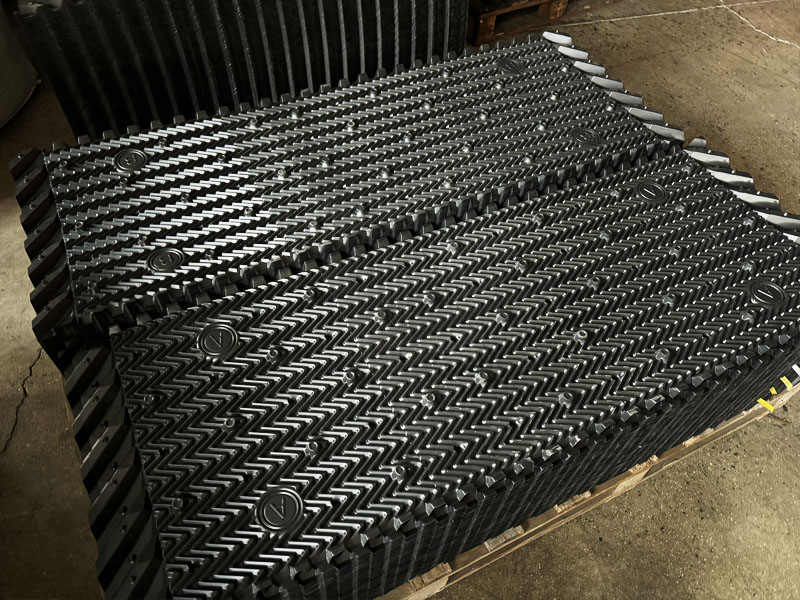
- Select Fill Material — Choose PVC for standard temperature, PP for higher temperatures or aggressive water chemistry, or specialized materials for unique conditions.
- Size and Layout Verification — Measure cell dimensions, support rails, and fill block sizes. Decide between standard blocks and custom-cut pieces.
- Procurement — Order replacement fill with lead time buffer. For critical plants consider keeping spare blocks in inventory.
- Install Plan — Schedule during planned shutdowns or low-load windows. Plan manpower, lifting equipment and safety procedures.
- Trial Piece — If unsure about a model, install sample blocks in one cell to compare measured improvement before full replacement.
Minimizing Downtime and Cost
Follow these practical tips to shorten downtime and lower total cost:
- Modular Replacement — Replace by cell or tier to keep parts of the tower operating when safe and compatible.
- Pre-Cut Custom Blocks — Provide manufacturer dimensions so blocks arrive ready-to-install, reducing onsite cutting time.
- Use Experienced Crew — Specialized teams can install quickly and correctly; errors elongate shutdowns.
- Coordinate with Water Treatment — Align replacement with water chemistry adjustments to reduce early fouling risk on new fill.
- Stock Critical Items — Keep spare nozzles, hangers and a few fill blocks for emergency swaps.
Cost Benefit Considerations
Evaluate replacement cost versus ongoing operational penalty:
- Energy Savings — Improved heat transfer typically reduces fan and pump power consumption quickly, providing fast payback.
- Maintenance Savings — New fill requires less frequent cleaning and reduces labor cost.
- Equipment Protection — Proper cooling lowers stress on condensers, heat exchangers and downstream equipment.
- Extended Life — Modern fill materials often outlast older designs, stretching intervals between replacements.
Selecting Replacement Fill Type
Match fill type to operating conditions and maintenance expectations:
- PVC Film Fill — High thermal performance for clean water systems and typical industrial temperatures.
- PP Fill — Better high temperature resistance and chemical durability for harsh process water.
- Splash Fill — Robust option where water carries heavy solids or fouling agents.
- Corrugated Fill — Balanced performance for many crossflow and counterflow towers where both distribution and airflow matter.
After Replacement Commissioning
Be sure to verify performance after installation:
- Measure inlet and outlet temperatures and confirm approach meets expected values.
- Observe water distribution for uniform coverage.
- Check airflow characteristics and ensure no unexpected resistance.
- Update maintenance schedule and water treatment plan for new fill.
Where to Source Replacement Fill
Choose suppliers with proven factory capacity, customization capability and export experience. For product details visit the Cooling Tower Fill product page. For a complete component solution consider the Air Intake Grille and Cooling Tower Water Collector to complement new fill performance.
Summary
Timely replacement of cooling tower fill restores thermal performance and reduces energy cost. Use a combination of inspection, performance monitoring and water analysis to decide the optimal replacement timing. Plan replacements carefully to minimize downtime and align water treatment strategy with new fill characteristics.
Plan Your Cooling Tower Fill Replacement
If you are unsure about replacement timing or need a quotation, send us your tower dimensions, photos or fill sample. Our engineering team will review your data and recommend the fastest, most cost effective replacement plan.
Send Drawings and Request Quote

Leave a comment
All fields marked with an asterisk (*) are required